






Inside the article
Request a product demo
Get a demo and clarify your doubts about our software.
Key Takeaways
- The U.S. is the largest car rental market in 2026, and Enterprise, Hertz, and Avis remain the top leaders.
- Online and mobile bookings dominate the industry, making digital platforms the main way people rent cars.
- Rising costs, such as insurance, fuel, and vehicle prices, are putting pressure on rental companies.
- Long-term rentals, subscriptions, and corporate rentals are growing faster than traditional short-term rentals.
- Technology like AI, dynamic pricing, and mobile apps is transforming the industry into a fully digital mobility service.
Car rental market overview
The U.S. car rental industry is entering 2026 with plenty of momentum. Travelers today expect more than just a vehicle. They want a quick booking process, flexible rental options, and a smooth pickup experience. That's pushing rental companies to rethink how they operate and deliver better service at every step.
Demand remains strong across business travel, family vacations, and everyday transportation. At the same time, companies are investing in smarter technology, expanding EV fleets, and introducing features like mobile bookings, digital check-ins, and contactless pickup. In 2026, the companies that make renting faster, easier, and more convenient are the ones most likely to stand out.
Car rental market size & key statistics
The car rental market is growing steadily worldwide, and robust data from trusted research shows how quickly the industry is expanding.
According to Mordor Intelligence, the global car rental market is valued at around $153.47 billion in 2025 and is expected to reach $169.36 billion in 2026. This shows clear growth driven by increasing travel demand, airport mobility, and digital booking platforms. The industry is also projected to grow at a strong 10.36% CAGR through 2031, proving that car rentals are becoming a long-term global mobility solution.
More people are choosing online bookings, contactless rentals, and app-based services instead of traditional counters. These changing customer preferences are encouraging rental companies to invest in better technology and deliver faster, more convenient rental experiences.
What's driving the growth of the car rental market?
Rising tourism & business travel
Travel habits have changed over the past few years. Instead of planning just one major vacation, many Americans are spreading their travel across the year with weekend breaks, road trips, and quick city escapes. Business travel also remains steady, with professionals frequently renting cars for meetings, conferences, and client visits.
This consistent mix of leisure and business travel keeps demand high throughout the year. Airports in popular destinations like Orlando, Las Vegas, and Los Angeles continue to see strong rental activity as travelers look for a convenient way to get around as soon as they land.
Growth of online & mobile bookings
Think about booking a rental car today. Most people don't walk up to a rental counter anymore. Instead, they pull out their phone, compare a few options, choose a car, and book it in just a few minutes, often before they even leave home.
That's exactly how the car rental industry is changing. People now expect fast online bookings, mobile apps, digital check-ins, and contactless pickup.
Demand for flexible mobility
Not everyone needs a car every day. Some people rent one for a weekend getaway, while others need it for a few weeks during a relocation or until their new car arrives. Instead of paying for a car year-round, many prefer renting only when it fits their needs.
This is why flexible and long-term rentals are becoming more popular than ever.
Corporate fleet rentals
Behind the scenes, companies are one of the biggest drivers of this market.
Businesses need cars for employees, meetings, and operations in different cities.
Instead of owning fleets, they now prefer renting, because it's simpler and more cost-efficient.
EV transition
Electric cars are slowly entering rental fleets, but the shift is still in progress.
Hertz wanted 25% of its cars to be electric by 2024, but it did not work as planned. Not many customers rented EVs, and electric cars also became cheaper faster than petrol cars. So, Hertz sold around 20,000 EVs, lost about $245 million, and EVs dropped to only about 11% of its fleet.
Enterprise is moving in the opposite direction. In 2026, it announced a 30% increase in EV fleet size, adding more than 15,000 electric vehicles like the Tesla Model 3 and the Ford Mustang Mach-E.
So, one company is reducing EVs while another is expanding them, showing that EV adoption in car rentals is still in a testing phase and not fully settled yet.
AI & connected fleet technologies
Car rental companies are no longer just about cars; they are becoming tech companies too. Most people don't see this part of car rentals, but a lot of smart technology works behind the scenes.
AI-powered car rental software helps rental companies generate smart pricing suggestions, identify vehicle damage, and streamline check-ins. What once took 20 minutes at a rental counter can now be completed in just a few taps on a phone.
Rental costs change based on demand, location, and even weather. Because of this, car rentals are becoming faster, smarter, and more convenient for customers in 2026.
Latest car rental market trends in 2026
Industry experts at the International Car Rental Show 2026 said rental companies are taking a smarter approach to growth. Instead of adding more vehicles whenever demand increases, they are focusing on building profitable and efficient fleets that can adapt to changing market conditions.
This trend is already visible in the market. Both Hertz and Avis reduced the number of vehicles in their fleets while keeping them newer than ever. Newer cars need fewer repairs, cost less to maintain, and offer a better experience for customers. Instead of growing quickly, many rental companies are focusing on running smarter and more efficient fleets.
That's only part of the story, though. A few other trends are worth watching closely:
- Off-lease vehicle returns are surging: Analysts expect off-lease vehicles entering the market to rise by roughly 40% in 2026, reshaping how operators source and remarket fleet vehicles.
- Fuel and inflation pressure are back: Industry analyst John Healy noted that fuel prices in the U.S. Midwest reached nearly $5 per gallon in early 2026. As travel costs change, rental companies are adapting their pricing and fleet strategies to meet customer needs.
- Direct EV Rentals: Tesla has started renting electric cars directly to customers in California for around $60 a day. This gives customers another rental option and encourages rental companies to offer more competitive pricing and services.
- Peer-to-Peer Rentals Are Growing: While some companies have left the market, peer-to-peer car rentals continue to grow. For example, Getaround ended its U.S. operations in 2025, while Turo is expected to generate more than $1 billion in annual revenue, showing that demand for this rental model remains strong.
So what does this mean for the year ahead? An industry that's learned to grow more carefully, watch costs closely, and treat technology as infrastructure rather than a nice-to-have.
Want to capitalize on these market trends? Check out our step-by-step guide on how to start a car rental business before launching your own rental service.

Thinking about starting a car rental business?
Download our Free Car Rental Guidebook and learn the exact steps to launch, manage, and grow your rental business.
Car rental market segmentation
By vehicle type
- Economy Cars
- SUVs
- Executive Cars
- Luxury Cars
By booking type
- Online Booking
- Offline Booking
By rental duration
- Short-Term Rentals
- Long-Term Rentals
By purpose
- Leisure / Tourism
- Business Travel
By customer type
- Individual Customers
- Corporate Customers
- Insurance Replacement Customers
- Peer-to-Peer Users
Regional analysis
North America
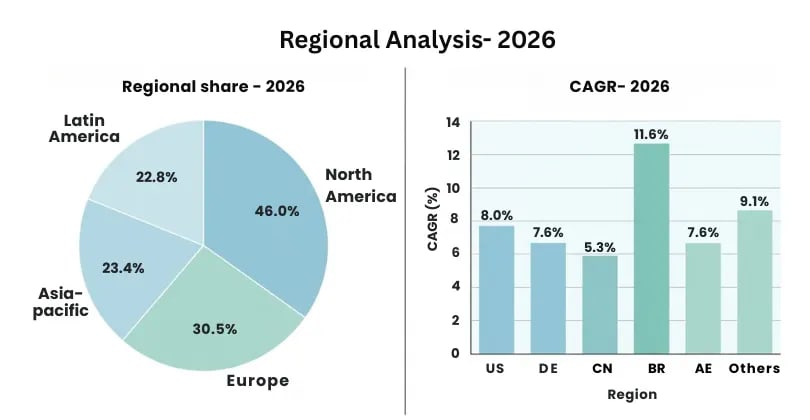
North America remains the largest car rental market in 2026, led mainly by the United States. It holds around 38% - 45% of the global share, with strong demand from airports, business travel, and domestic tourism. The U.S. market alone is valued at roughly $50- 60 billion in 2026, making it the core revenue driver for global rental companies.
In 2026, the region continues to grow steadily at around 6% - 7% CAGR, supported by high digital booking adoption and the strong presence of major players like Enterprise, Hertz, and Avis.
Europe
Europe contributes around 25% - 33% of the global share. Demand is driven by tourism, cross-border travel, and business mobility, especially in countries like Germany, the UK, and France.
The region is growing at a steady 5%-7% CAGR in 2026, with a strong shift toward electric vehicles and sustainable rental fleets due to strict environmental regulations.
Asia-Pacific
Asia-Pacific is supported by rising tourism, urbanization, and digital-first booking platforms. China and India are the biggest contributors to growth.
The region holds about 20%-26% market share and is expanding rapidly at a 10%-13% CAGR in 2026, making it the strongest growth engine globally.
Latin America
Latin America is mainly led by Brazil and Mexico. Growth is driven by tourism, airport rentals, and improving transport infrastructure.
The region holds around 7%-8% market share and is growing at a 6%-8% CAGR in 2026.
Middle East & Africa
The Middle East and Africa region has strong demand from tourism and luxury travel, especially in the UAE and South Africa.
It holds around 4%-7% market share, growing at a 6%-9% CAGR in 2026, supported by tourism development and infrastructure expansion.
Competitive landscape: key players in car rental companies
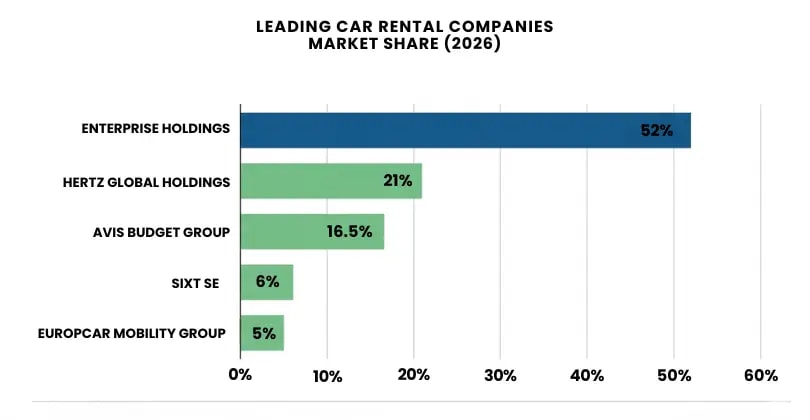
The companies listed above are some of the leading players in the global car rental market.
Enterprise holdings
Enterprise is the largest car rental company in the world. It runs a huge network of rental locations across airports, cities, and local neighborhoods, especially in the United States.
It leads the market because of its strong presence in corporate rentals and insurance replacement services. Enterprise holds around 50%-55% of the U.S. car rental market, making it the clear leader in 2026.
Hertz
Hertz is one of the oldest and most well-known car rental brands in the world. It is mainly strong in airport rentals and international travel markets, where demand is high from tourists and business travelers.
In 2026, Hertz is focusing on improving profits by reducing costs and modernizing its fleet. It holds about 20-22% of the U.S. market, making it one of the top competitors behind Enterprise.
Avis budget group
Avis Budget Group operates popular brands like Avis, Budget, and Payless. It serves both budget travelers and premium customers, making it flexible across different segments.
The company is growing through digital booking systems and partnerships with travel platforms. It holds around 15%-18% of the U.S. market, making it a strong competitor in airport and city rentals.
Sixt SE
Sixt is a fast-growing company based in Europe and expanding strongly in North America. It is known for offering premium and luxury vehicles along with a modern digital booking experience.
In 2026, Sixt is gaining attention because of its focus on technology, EV expansion, and customer experience. It holds around 5%–7% of the global market, with strong growth in Europe and the U.S.
Europcar mobility group
Europcar is one of the biggest car rental companies in Europe. It offers traditional rentals along with car sharing and mobility services, making it more flexible than older models.
The company is focusing on sustainable travel and electric vehicle adoption in 2026. It holds around 4%–6% of the global market share, mainly in European countries.
Challenges facing the car rental market
- Insurance costs are rising due to increasing vehicle theft cases.
- Vehicle theft in the U.S. crossed 1 million, increasing the risk for rental companies.
- Repair times have increased to around 22 days, reducing fleet availability.
- High car prices and tariffs make fleet replacement expensive.
- EV resale value is uncertain, causing financial losses for some companies like Hertz.
Understanding these challenges is essential for success. Learn more about the pros and cons of a car rental business to make informed decisions.
Opportunities for new car rental businesses
Even with challenges, the market still has strong growth opportunities for new players. One major opportunity is long-term and subscription-based rentals, where customers rent cars for weeks or months. This segment is growing faster than traditional short-term rentals because people want flexible access instead of ownership.
There is also strong potential in smaller cities and secondary airports, where big companies are less active. New businesses can also grow through corporate partnerships, especially as business travel continues to rise. These areas give smaller operators a chance to build stable income without competing directly with large global brands.
Turning these opportunities into revenue requires the right marketing strategy. Read our guide on how to market your car rental business to reach more customers and increase bookings.
Technology transforming the car rental industry
Technology is reshaping the car rental industry by making operations more efficient and customer-friendly. Fleet management platforms now track vehicle availability, maintenance schedules, and usage in real time, helping rental companies reduce downtime and improve fleet utilization.
Electric vehicles are also becoming a bigger part of rental fleets as companies respond to growing demand for sustainable travel. At the same time, connected car technology enables remote vehicle monitoring, automated maintenance alerts, and improved security, giving both rental providers and customers a more reliable rental experience.
Conclusion
The car rental market in 2026 is moving in a strong and positive direction. Travel demand is rising again, business activity is improving, and people are choosing flexible transportation options more than ever. This steady demand is helping the industry grow across both the U.S. and global markets.
At the same time, the industry is becoming smarter and more advanced. Companies are adopting digital booking systems, AI-powered automation, and modern fleet management solutions. Businesses looking to capitalize on these trends can streamline operations and deliver a better customer experience by using a car rental script, which provides features like online reservations, fleet management, payment processing, and customer management in a single platform.
Even with challenges like rising costs and evolving EV adoption, the market continues to adapt and remain resilient. Overall, the future of the car rental industry looks promising. With strong demand, better technology, and innovative business models, the sector is well-positioned for long-term growth.
Request a product demo
Get a demo and clarify your doubts about our software.

