






Inside the article
Request a product demo
Get a demo and clarify your doubts about our software.
Key Takeaways
- Online marketplaces now account for more than 83% of worldwide eCommerce GMV, with global marketplace GMV reaching $3.8 trillion in 2026.
- Every marketplace needs three panels: a buyer storefront, a vendor dashboard, and an admin panel to manage the platform.
- Building a marketplace from scratch costs $50,000 to $500,000 and takes 6 to 12 months. Ready-made Amazon clone software cuts that to weeks.
- Multi-vendor platforms generate revenue through commissions, listing fees, vendor subscriptions, and featured placement without holding any inventory.
- RSCart's Amazon Clone comes with the full buyer, vendor, and admin panel infrastructure, 100% source code, and a one-time cost - no recurring license fees.
Online marketplaces have become the default way most people shop. Amazon built its third-party marketplace over decades and generated approximately $750 billion in seller GMV in 2026 alone. What has changed is that the same marketplace model is now within reach for any entrepreneur willing to build a focused platform in a specific niche or region.
The interest in building marketplace platforms keeps growing because the revenue model is straightforward: you earn from every sale without holding inventory, managing stock, or running logistics yourself.
In this blog, we'll cover what a multi-vendor marketplace is, the features it needs, the three main ways to build one, seven steps to get it live, and how the revenue model works.
What is a multi-vendor marketplace like Amazon?
A multi-vendor marketplace is a platform where multiple independent sellers list and sell products through a single storefront that you own and operate. You do not hold inventory. You earn commission or fees on every transaction that runs through your platform.
The model has become the dominant structure in global online retail. Online marketplaces now account for more than 83% of worldwide eCommerce GMV, with global marketplace GMV reaching $3.8 trillion in 2026, according to eMarketer and Marketplace Pulse.
Amazon is the most recognizable example, but the same architecture powers thousands of niche platforms across B2B, B2C, and service categories. eBay built it for second-hand goods. Etsy built it for handmade products. Platforms of every size run on this model.
Multi-vendor marketplace features: what to build first
A marketplace needs three distinct panels working together. Each one serves a different user, and all three have to function well before your platform can operate at any scale.
Buyer features
The buyer experience determines whether people come back. Core features the storefront needs:
- Product search with filters by category, price, seller rating, and location
- Seller profiles and ratings so buyers can evaluate vendors independently
- Secure checkout with multiple payment methods and real-time order tracking
- Wishlist and saved items for repeat visits
- Mobile-optimized interface since most marketplace browsing happens on phones
Vendor dashboard features
Sellers will not stay on a platform that is hard to manage. The vendor dashboard needs to cover:
- Product listing management with bulk upload and inventory tracking
- Order management with fulfillment status updates and payout visibility
- Sales analytics and earnings dashboard
- Promotional tools including discount codes and featured listing options
- Configurable payout schedules to match different seller preferences
Admin panel features
The admin panel is how you run the platform day-to-day. It needs to handle:
- Vendor onboarding, verification, and approval workflows
- Commission configuration per category or seller tier
- Dispute resolution and refund management
- Platform-wide analytics covering GMV, revenue, and seller performance
- Content moderation for listings that violate platform policies
3 ways to build a multi-vendor marketplace like Amazon
Build from scratch with custom development
Custom development gives you full control over the architecture, features, and user experience. The trade-off is cost and time. Building a multi-vendor marketplace from scratch typically costs between $50,000 and $500,000, depending on complexity, and takes 6 to 12 months to reach a working MVP.
For most entrepreneurs validating a marketplace concept, that timeline and budget are hard to justify. Custom development makes more sense for large enterprises with unique technical requirements that no off-the-shelf product can meet.
Build with AI tools
AI-assisted development tools can generate code faster than a traditional development team. The limitation is specificity. Marketplace platforms require logic that general-purpose AI tools handle poorly: multi-party payment splitting, vendor permission structures, commission calculation, and dispute workflows all need architecture that generic code generation does not produce reliably.
AI tools are useful for specific components of a marketplace build. They are not a viable standalone path to a production-ready multi-vendor platform.
Use ready-made Amazon clone software
Ready-made Amazon clone software gives you the full marketplace infrastructure already built and tested. RSCart's Amazon Clone is a white-label solution with the buyer storefront, vendor dashboard, and admin panel ready to deploy. It comes with 100% source code, a multi-domain license, and a one-time cost. Entrepreneurs can launch their own multi-vendor marketplace in weeks rather than months, without assembling a development team.
If you are validating a marketplace concept and want to avoid a six-figure dev budget before you have a single vendor, this is where most founders start.
7 steps to create a multi-vendor marketplace website like Amazon
Step 1: Choose your niche and marketplace type
A broad general marketplace competing head-to-head with Amazon is not a viable entry strategy. The better approach is a specific niche where you can recruit sellers that the major platforms underserve. A niche marketplace has lower customer acquisition costs and higher seller loyalty because you can offer something the giants cannot: focused curation, a specific buyer community, or category expertise.
Step 2: Validate demand with real sellers and buyers
Before building anything, confirm that sellers want a new platform in your niche and that buyers have a real reason to use it. Talk to potential vendors. Understand what frustrates them about existing platforms. Identify what buyers cannot find on Amazon or eBay that your marketplace could offer. Skipping this step is the most common reason new marketplaces fail.
Step 3: Pick your business model and set your commission
Your commission rate is the core monetization decision. Most general marketplaces charge 10 to 20 percent. Niche B2B platforms often charge less but add monthly subscription fees for vendors. Set a rate that makes the platform economically viable while remaining attractive enough to retain sellers who already have alternatives.
Step 4: Design the buyer and vendor experience
Map the key journeys before writing any code.
- How does a buyer find a product, evaluate a seller, and complete a purchase?
- How does a vendor list a product, fulfill an order, and receive a payout?
Every friction point in these journeys directly affects seller retention and buyer conversion. Designing the experience on paper first saves significant rework later.
Step 5: Build and test your MVP with your chosen approach
Launch a minimum viable version of the platform with the core features working end to end: search, product listings, checkout, payment, and vendor payouts. Avoid building advanced features before the fundamentals are tested with real users. The platforms that struggle at launch usually build too much too early, not too little.
Step 6: Set up split payments, vendor verification, and trust tools
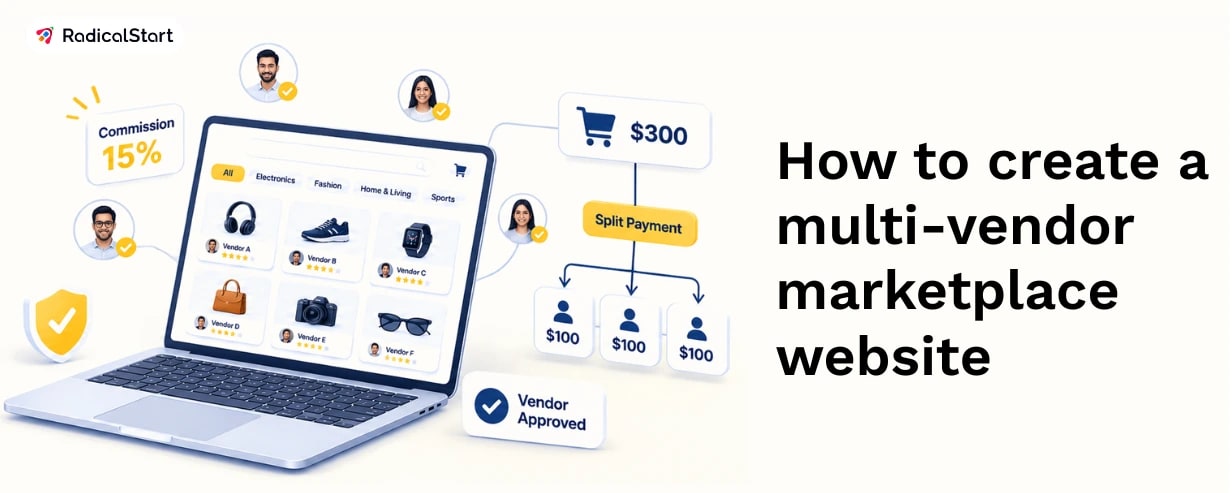
Split payments route a buyer's payment automatically to both the platform and the vendor. Getting this right is operationally essential and legally complex. Vendor verification prevents fraudulent sellers from listing on your platform. Ratings, reviews, and dispute resolution build buyer trust. These systems need to be in place before public launch, not patched in after.
Step 7: Launch and onboard your first vendors
Launch with a focused group of vendors rather than trying to recruit at scale immediately. Early vendors set the quality standard for the platform. Work closely with them, gather feedback, and use their experience to fix onboarding friction before opening applications broadly. Twenty vendors who trust the platform will do more for your growth than two hundred who barely use it.
How do multi-vendor marketplaces make money?
Multi-vendor marketplaces generate revenue through several streams that compound as the platform grows. None of them require the platform to hold inventory or manage fulfillment directly.
Commission per transaction: a percentage of each sale, typically 5 to 20 percent depending on the product category
- Listing fees: a fixed fee per product listed, common in categories with high listing volume
- Vendor subscription plans: monthly or annual fees for sellers who want premium features, higher visibility, or increased product limits.
- Featured placement: vendors pay to appear at the top of search results or category pages
- Advertising: sellers bid on promoted placement within search results, similar to how Amazon's sponsored products model works
The model scales without proportional cost increases. As GMV grows, commission revenue grows with it. The platform owner earns more from every new seller and every new order without taking on additional inventory, fulfillment, or logistics overhead.
Conclusion
Multi-vendor marketplaces have become the standard in global eCommerce for a simple reason: the model works for everyone involved. The platform owner earns from every transaction without holding inventory. Sellers get distribution they would spend years building on their own. Buyers get selection and competitive pricing in one place.
Getting from concept to a live platform used to require a large development budget and a long build cycle. Ready-made Amazon clone software has changed that. If you are ready to build your own marketplace, RSCart's Amazon Clone gives you the full buyer, vendor, and admin panel infrastructure to launch in weeks, not months.
Request a product demo
Get a demo and clarify your doubts about our software.

