






Inside the article
Request a product demo
Get a demo and clarify your doubts about our software.
Key Takeaways
- Choose the right delivery app type, such as food, grocery, medicine, parcel, or multi-delivery, based on your target customers and business goals.
- Include essential features like customer ordering, driver management, merchant dashboards, admin controls, real-time tracking, payments, and notifications to run a successful delivery platform.
- Select the right development approach by comparing options like building from scratch, using a ready-made delivery solution, or partnering with a technical co-founder.
- Follow a structured process to create a delivery app, including choosing a business model, planning features, designing the app, development, testing, launching, and marketing.
- A multi-delivery app helps businesses serve multiple customer needs, create additional revenue streams, improve delivery efficiency, and expand into new markets.
- Choosing a customizable delivery solution allows startups to launch faster, reduce development costs, and scale their platform with future features and services.
Introduction
The demand for delivery apps is growing every year as more people order food, groceries, medicines, and parcels online. If you are planning to start a delivery business, having your own app can help you reach more customers and manage your operations more efficiently.
In this guide, you will learn the different types of delivery apps, the features you need, and the step-by-step process to build and launch your own delivery platform.
Types of delivery apps you can build
Before you begin building a delivery app, determine what kind of delivery service you want to provide. Every delivery business has different customer needs, so choosing the right category helps you plan your features, pricing, and business model more effectively.
Food delivery app
A food delivery app allows customers to order meals from restaurants and cloud kitchens and have them delivered to their doorstep. Popular apps include DoorDash, Uber Eats, and Grubhub. As of 2026, DoorDash holds around 56% of the US food delivery market.
The global online food delivery market was valued at USD 350.63 billion in 2026 and is expected to reach around USD 728.83 billion by 2034. It is one of the most mature and competitive delivery categories, making it a good option for businesses that can serve a specific niche or local market.
Grocery delivery app
A grocery delivery app allows customers to order groceries, fresh produce, and household essentials online and receive them at home. Popular apps include Instacart, Amazon Fresh, and Walmart Grocery.
The global grocery delivery app market was valued at USD 4.3 billion in 2025 and is expected to reach USD 12.4 billion by 2033. Around 30% of US households already use grocery delivery services, showing steady demand as more people choose online shopping.
Medicine delivery app
A medicine delivery app allows customers to order prescription medicines, non-prescription medicines, and healthcare products online and receive them at their doorstep. Popular apps include CVS Pharmacy, Walgreens, and Amazon Pharmacy.
The global ePharmacy market is expected to grow from USD 177.79 billion in 2026 to around USD 733.38 billion by 2034. This is one of the fastest-growing delivery segments as more customers prefer ordering medicines online.
Parcel and courier delivery app
A parcel and courier delivery app helps individuals and businesses send packages, documents, and other shipments from one location to another. Popular apps include Lalamove and GoShare.
The global parcel delivery market was valued at USD 528.26 billion in 2026 and is projected to reach around USD 647.85 billion by 2032. Demand in this segment remains stable because businesses and e-commerce companies need reliable parcel delivery every day.
Multi-delivery app
A multi-delivery platform combines food, grocery, medicine, and parcel delivery into a single app. Instead of managing multiple apps for different services, customers can access everything from one platform. Companies like Postmates have shown that this model works successfully at scale.
The opportunity is also growing. The global delivery app market is projected to grow from USD 81.54 billion in 2025 to around USD 225.77 billion by 2035. As demand increases across food, grocery, pharmacy, and parcel delivery, a multi-delivery platform allows businesses to serve all these markets through a single application.
For entrepreneurs, this means multiple revenue streams instead of relying on just one type of delivery. It also improves driver utilization, as drivers can complete different types of deliveries during the same shift.

Want to explore a multi-delivery app?
See how food, grocery, and pharmacy delivery work together on a single platform.
Key features every delivery app should include
No matter which type of delivery app you build, there are four panels that every platform needs. Each one serves a different user and has its own set of features.
Customer app features
The customer app is what your users interact with every day. It needs to be simple, fast, and reliable.
- User registration and profile management
- Search by category, location, price range, and delivery type.
- Real-time order tracking with live map
- Multiple payment options, including cards, wallets, and cash on delivery
- View order history
- Ratings and reviews for merchants and drivers
- Push notifications for order status updates
- In-app chat feature.
Delivery driver app features
Your drivers are the backbone of your operation. Their app needs to make their job easy, not harder.
- Driver registration and document upload
- Incoming order notifications with accept or reject option
- GPS navigation with optimized route suggestions
- Order pickup and delivery confirmation
- Earnings dashboard and completed order history
- In-app chat with customers
- Driver can rate customers
Merchant dashboard features
If your platform includes restaurants, grocery stores, or pharmacies, they need their own dashboard to manage orders and daily operations.
- Store profile setup and menu management
- Real-time order notifications and acceptance
- Preparation time settings
- Order status monitoring
- Earnings and payout reports
- Promotional options for offers and discounts
- Review management
Admin panel features
The admin panel is where you manage everything. This is your control center.
- Customer, driver, and merchant management
- Order monitoring and dispute management
- Commission, payments, and payout management
- Analytics dashboard for revenue, orders, and business performance
- Notifications and content management
- Delivery zone and service area management
- Coupon and promotional campaign management
Different ways to create a delivery app
Build from scratch
Building from scratch means hiring a development team to design and code your app from the ground up. Every feature, workflow, and screen is designed specifically for your business requirements and needs.
Pros
- Complete control over features and app design
- Full ownership of the source code and platform
Cons
- High development cost, usually between $30,000 and $150,000
- Development can take 6 to 12 months before launch
Best fit
Large enterprises or businesses with highly specific requirements, enough budget, and the time to build and maintain a custom platform.
Use a ready-made delivery solution
A ready-made delivery solution is a pre-built platform that you can customize with your own branding and launch quickly. Instead of building everything from scratch, you start with a proven product and tailor it to your business needs.
Pros
- Launch your delivery platform faster compared to building from scratch
- Lower development cost, typically ranging from $5,000 to $8,000
- Core features are already built and tested
Cons
- Third-party tool integrations may need additional implementation
- Limited flexibility for deep customization
Best fit
Startups who want to validate their idea quickly without a large upfront investment. Also a strong choice for operators who want to launch fast and grow before committing to custom development.
Need a delivery platform with custom features? We can customize our ready-made delivery app solution to match your business requirements, branding, and workflows. This helps you launch faster while still getting a platform built around your delivery business.
Hire a tech co-founder
A tech co-founder is someone with technical skills who joins your startup and takes ownership in exchange for equity. Instead of paying upfront development costs, you share a portion of your business with someone who helps build and manage the technology side.
Pros
- No immediate development cost.
- Shared responsibility for product decisions and growth.
Cons
- You need to give up a percentage of your business ownership
- Finding the right co-founder can take significant time
Best fit
Non-technical founders who have a strong business idea and network but no development budget. Works best when both founders complement each other's skills clearly.
How to create a delivery app step by step
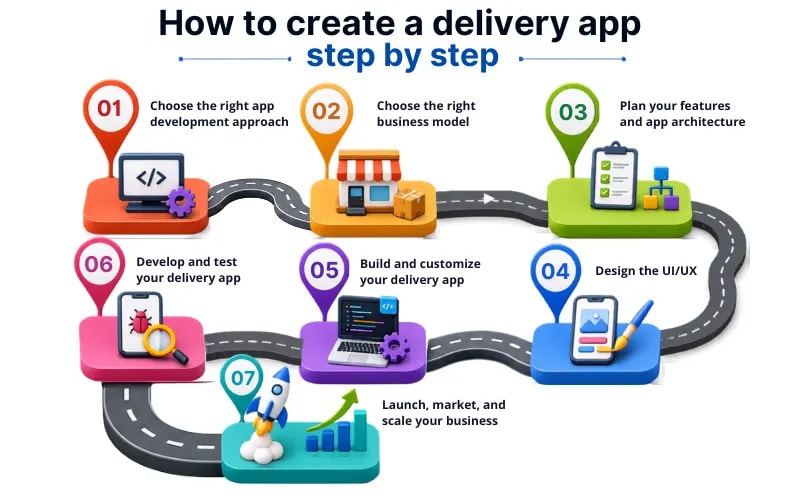
Step 1: Choose the right app development approach
Before starting development, decide how you want to build your delivery app. You can either build it from scratch, use a ready-made solution, or partner with a technical co-founder. This decision affects your budget, your timeline, and every decision that follows.
If you're still deciding between building a custom platform or choosing a ready-made solution, explore our detailed comparison of custom vs ready-made app development to understand which option best fits your budget, timeline, and business goals.
Step 2: Choose the right business model
Before building your app, decide what type of delivery platform you want to create and how it will generate revenue. Your choice of business model affects your features, operations, and overall app structure.
You also need to choose a revenue model that fits your business goals:
- Commission-based: You take a percentage of every order placed through your platform. DoorDash and Uber Eats use this model.
- Subscription-based: Merchants or customers pay a recurring fee for access to the platform. Some grocery apps use this.
- Delivery fee-based: You charge customers a flat or variable fee per delivery. Courier and parcel delivery businesses commonly use this model.
Most multi-delivery platforms combine commission and delivery fees for maximum revenue. Choosing the right business and revenue model early helps you plan the right features and build a platform that matches your target market.
Step 3: Plan your features and app architecture
Make a list of every feature your app needs before development begins. Separate them into two groups: what goes into the first version and what can wait for a future update.
Your app architecture covers how many panels you need, how data flows between them, and what APIs and third-party services you will integrate. Payment gateways, map services, and SMS notifications all need to be planned at this stage.
Step 4: Design the UI/UX
Your app design plays an important role in how users interact with your platform. A simple and easy-to-use interface encourages customers to complete orders without confusion.
Focus on creating a smooth ordering experience, from searching for products to checkout and delivery tracking. Keep navigation simple and follow familiar patterns that users already know from popular delivery apps.
A clean design is not just about appearance. It should make every step easier for customers, drivers, and merchants.
Step 5: Build and customize your delivery app
If you are using a ready-made solution, this step is where you apply your branding, set up your delivery zones, configure your payment gateway, and add your merchant listings. Most ready-made platforms let you do this without touching the core code.
If you are building from scratch, this is where your development team starts working through the feature list, starting with the core booking flow before adding secondary features.
Step 6: Develop and test your delivery app
Testing is one of the most important stages before launching your delivery app. A single issue in ordering, payments, tracking, or notifications can affect the user experience.
Test every important flow, including placing orders, accepting deliveries, tracking drivers, making payments, and handling cancellations.
Also, check your app on different devices and test how it performs when multiple users access it at the same time. Fixing issues before launch helps you provide a smoother experience from day one.
Step 7: Launch, market, and scale your business
Submit to the App Store and Google Play. Both have review processes that take a few days, so plan your launch date around that.
For marketing, start local. Pick one city or neighborhood, get your first 20 merchants onboard, and focus on filling your first 100 orders and collecting feedback to improve your service.
Local marketing, referral programs, social media campaigns, and search ads can help attract early users. Once your delivery model works in one area, you can expand into new locations and grow your platform.
Why creating a multi-delivery app is a smart move in 2026
A multi-delivery app lets you offer food, grocery, medicine, and parcel delivery through one platform. Instead of depending on a single service, you can generate revenue from multiple delivery categories while serving more customer needs.
Why businesses are shifting to multi-delivery apps
Customers prefer one app that handles different delivery services instead of using separate apps for each need. This is one reason more businesses are moving toward the multi-delivery model.
The opportunity is also growing. The global delivery app market is expected to grow from USD 81.54 billion in 2025 to around USD 225.77 billion by 2035. A multi-delivery platform helps businesses capture demand across food, grocery, pharmacy, and parcel delivery from a single application.
How to launch your own multi-delivery platform
To launch your own multi-delivery platform, you need a solution that supports multiple delivery services from day one. Your platform should include customer and driver apps, merchant dashboards, an admin panel, real-time order tracking, payment integration, and delivery management tools.
Our multi-delivery app solution comes with all these features already built. You can customize it with your own branding, configure your business settings, onboard merchants and delivery partners, and launch your platform without starting from scratch. As your business grows, you can also add new features and expand into additional delivery categories.
Conclusion
Building a delivery app involves more than just developing software. It requires choosing the right business model, adding the right features, and selecting a development approach that fits your goals. With proper planning and the right platform, you can build a delivery app that supports your business today and grows with it in the future.
Request a product demo
Get a demo and clarify your doubts about our software.

