






Inside the article
Request a product demo
Get a demo and clarify your doubts about our software.
Key Takeaways
- SEO in 2026 is about visibility across Google, local search, and AI platforms, not just rankings.
- Start with a strong foundation, including competitor research, technical SEO, keyword strategy, and proper site structure.
- Focus on local SEO to capture high-intent searches through Google Business Profile, citations, and location pages.
- Create targeted content for both landlords and tenants to build trust and drive consistent traffic.
- Build authority through high-quality backlinks and relevant industry mentions.
- Optimize your content for AI tools and voice search using a clear, conversational, answer-focused structure.
- Track performance using tools like Google Analytics 4 and Google Search Console to measure real leads and ROI.
- Treat SEO as an ongoing strategy and continuously refine it to scale across locations and markets.
Introduction
If you're building or running property management software, you already know how competitive the marketplace is. Every other platform claims to be smarter, faster, or more scalable. New features are popping up everywhere. Your growth doesn't just depend on how good your product is. It depends on how easily the right people can find you.
Because in 2026, your potential customers are not waiting for recommendations. They're searching, comparing, and even asking AI tools which platform they should trust. And if your brand is not showing up in those moments, you are already a step behind.
That's exactly where SEO for property management companies comes in.
Strategies to Build SEO for Property Management Companies
Building effective SEO in 2026 is all about following a clear, phased approach rather than trying to do everything at once.
Phase 1: Foundation
Every successful SEO strategy starts with a solid foundation. This includes competitor research, technical optimization, keyword planning, and a clear website structure. Skipping these basics often leads to poor performance later.
Competitor Analysis
Before you make any moves, take a step back and look at who's already winning in your space. Look at their keywords, how their pages are structured, and how they guide users. The goal isn't to copy them, it's to find gaps you can do better.
For example, using SEMRUSH Keyword Gap, you can enter your domain and a competitor's domain to uncover keywords they rank for that you don't, or you can find where you're underperforming.
Example
The image shows the keyword overlap between Appfolio and Buildium found using the SEMRUSH Keyword Gap tool.
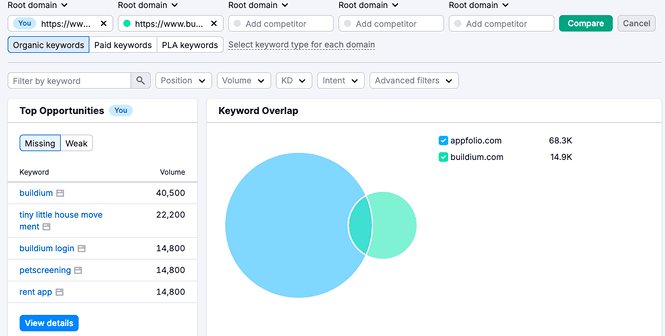
SEMRUSH Keyword Gap for Buildium and Appofolio
Technical SEO Audit
A strong technical SEO audit is what holds your entire SEO strategy together. You can have great content, but if your website is slow, hard to crawl, or not properly indexed, it simply won't perform the way you expect.
Here are the core technical elements you need to get right:
- Ensure your website is easily crawlable so search engines can properly access and index important pages.
- Optimize site speed and improve Core Web Vitals for better performance and user experience.
- Avoid heavy JavaScript dependency for critical content, as it may affect search engine visibility.
- Maintain a strong internal linking structure to improve navigation and page discoverability.
- Secure your website with HTTPS and regularly fix broken links, crawl errors, and duplicate or thin content issues.
- Keep your XML sitemap updated and submit it through Google Search Console so your pages are properly indexed.
- Add structured data (schema markup) for business details, properties, reviews, and FAQs to improve visibility in search results.
Example
A property management company, DoorLoop, identified performance issues through a technical SEO audit, including slow page load times and poor Core Web Vitals.
By optimizing site speed, fixing technical errors, and improving overall site structure, they enhanced user experience. They significantly improved their Core Web Vitals, leading to better search rankings and higher engagement.
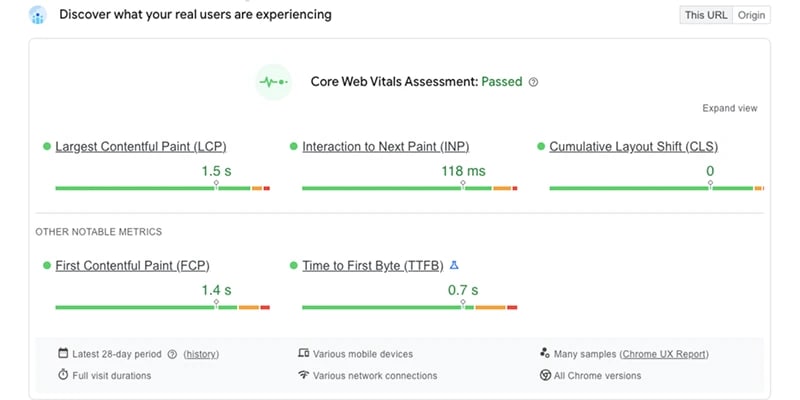
Improved Core Web Vitals of DoorLoop
Keyword Research for Rental Terms
Keyword research is the foundation of property management SEO because it connects your content with real user intent from both landlords and tenants.
Example
❌ Do not use: High-volume keywords "property management services" without understanding search intent.
✅ Focus on high-intent keywords like "property management in Texas," tenant searches like "apartments for rent in Austin," and long-tail queries such as "how much does property management cost in Texas."
This helps to improve search visibility and attract more qualified traffic from both Google and voice search platforms.
Structure Pages for Owners, Tenants & Locations
A clear and well-organized website structure makes it easier for both users and search engines to understand your content. Create dedicated pages for property owners focused on services such as rent collection, tenant management, maintenance, and reporting.
Example
Companies like HomeRiver Group follow a well-defined page structure by creating separate sections for each audience. They have a dedicated tenant listings page, a location-based offices page, and a property management services page for owners. This separation helps users quickly find relevant information while also improving SEO by aligning each page with specific search intent.
Take a look at their pages,
HomeRiver location-based pages - https://www.homeriver.com/office-locations
HomeRiver service pages for owners - https://www.homeriver.com/property-management
Phase 2: Local Visibility
According to Safari Digital, 78% of local mobile searches lead to real-world actions, making local SEO a critical starting point for property management growth. Strong local visibility begins with optimizing your key business signals across search platforms.
Optimize Google Business Profile
Your Google Business Profile is a key driver of local visibility and often acts as your second homepage.
Example
To fully optimize Google Business Profile, Rentvine has added accurate details and the right category, like "Property Management Company," and a clearly defined service area, which helped to make it locally visible in search engines.
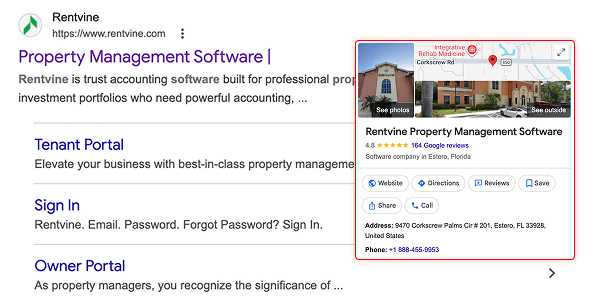
Rentvine's Google Business Profile
Rentvine has also added quality photos to keep the Google Business Profile active with regular updates and replies to encourage genuine reviews.
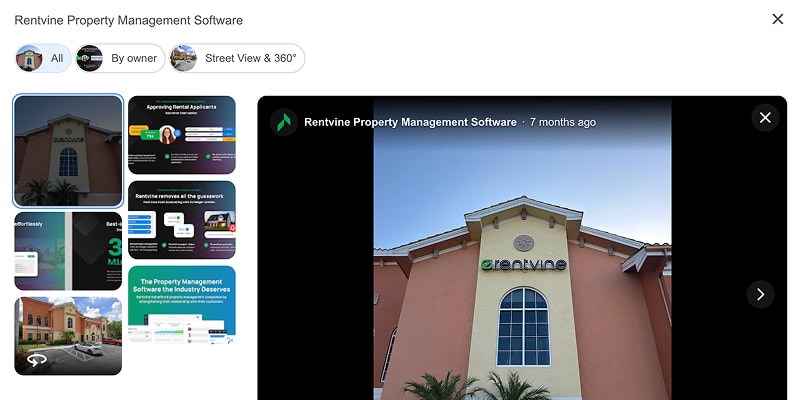
Rentvine’s photo added to Google Business Profile
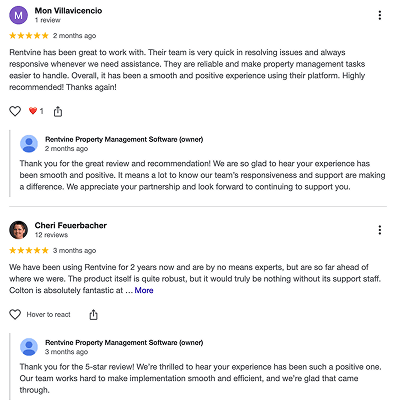
Rentvine’s reply to the review
Build Local Citations & NAP
Local citations help strengthen your visibility by ensuring your business details are consistent across the web. Make sure your Name, Address, and Phone number are the same on all platforms, including directories and listing sites. Even small inconsistencies can impact your rankings, so it's important to maintain accuracy everywhere.
Example
To build a local citation, Rentvine has also maintained consistency in listing the details across all platforms.
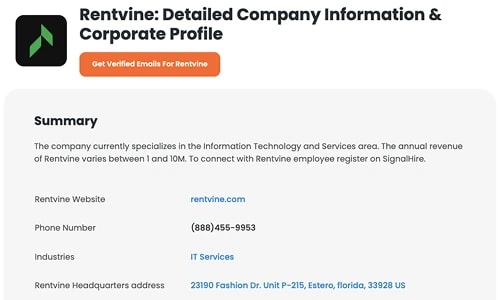
Rentvine’s listing in SignalHire
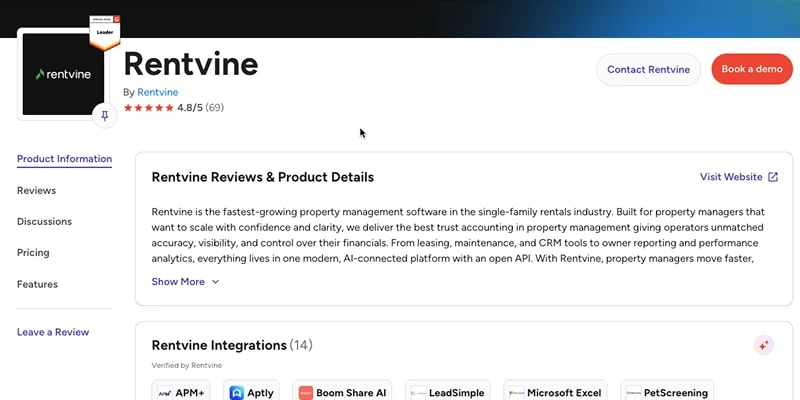
Rentvine’s listing in G2
Phase 3: Content Strategy
In 2026, content strategy is about clarity, intent, and consistency. Prioritize answering real questions with simple, useful information.
Content Marketing for Landlords & Tenants
In 2026, Content marketing is not just about publishing blogs for the sake of it. It's about creating helpful, trust-building content that speaks directly to landlords and tenants while also signalling authority to search engines and AI tools.
Example
Focus on practical topics like reducing vacancies, choosing the right property manager, and improving rental income.
For tenants, keep it helpful and simple with content like rental guides, neighbourhood insights, and move-in tips.
FAQ Pages for Tenant & Landlord Queries
Well-structured FAQ pages help you rank for question-based searches and improve your chances of appearing in featured snippets and AI-driven results.
Example
For landlords, include questions about property management services, fees, tenant screening, maintenance handling, and vacancy timelines.
For tenants, focus on common concerns like rental applications, rent payments, lease rules, and maintenance requests.
Keep answers short, clear, and conversational so users can quickly find what they need.
Phase 4: Authority Building
Authority building is what helps your property management website move from just being visible to actually being trusted by search engines and users.
Link Building
In 2026, link building is less about quantity and more about earning high-quality, relevant mentions from the real estate, rental, and local business ecosystem. Do not use spammy backlinks, paid link networks, or irrelevant directory listings that don't relate to real estate or property management.
Example
Use this for better ranking: Publishing authoritative resources like "2026 California Rental Market Report" or practical guides such as "Strategies to Reduce Tenant Turnover in Texas" helps attract organic backlinks and mentions from real estate blogs, investor communities, and industry publications.
Phase 5: AI & Scale
Search is no longer limited to Google rankings. Users now rely on AI tools and voice assistants for instant answers. For property management companies, visibility depends on being cited in AI-driven responses.
Optimize for AI, ChatGPT & Voice Search
Always start by structuring your content around real user questions. Answer the user's question directly, no fluff.
If you are writing an article for "What does a property manager in Texas typically charge?"
❌ Do not use: "The property manager charges $20."
✅ Use this for AI citation: "Property managers in Texas typically charge $20/ hour."
Voice search has transformed how users find property management services today.
❌ Do not use: Short keyword-style searches like "Property management fees Texas".
✅ Use this for AI citation: "How much does a property manager charge in my area?" or "Who handles rental property maintenance near me?"
Phase 6: Measure & Scale
In 2026, SEO is not something you set up once and leave running. Growth depends on tracking performance and making data-driven improvements. Traffic alone is not enough if it doesn't generate real leads. Measuring results helps you focus on what actually drives landlord and tenant inquiries.
Set Up Tracking & Rank Monitoring
To effectively measure your property management SEO performance, set up a tracking system that connects traffic to real business outcomes.
Use Google Analytics 4 to monitor organic traffic, user behaviour, and key conversions, and Google Search Console to track impressions, clicks, indexing, and search queries.
For website performance, use tools like SEMRUSH to run a Site Audit and evaluate your site’s overall health.
Along with this, regularly review your Google Business Profile insights and use call and conversion tracking to clearly understand which channels are driving actual leads, not just traffic.
Conclusion
In a competitive industry like property management, long-term growth depends not just on operations but also on visibility.
As an entrepreneur planning to launch a property management company, building a scalable software platform with a strong SEO foundation is essential to get discovered by landlords and tenants. Instead of starting from scratch, you can partner with RadicalStart to develop a solution with built-in SEO features, helping your business rank better, attract the right audience, and grow consistently.
Request a product demo
Get a demo and clarify your doubts about our software.

