






Inside the article
Request a product demo
Get a demo and clarify your doubts about our software.
Key Takeaways
- White-label apps enable faster launches with lower upfront investment and ready-to-use core features
- Custom apps provide full control over pricing, dispatch logic, branding, and data ownership
- White-label works best for early market testing, while custom development supports long-term scaling
- White-label provides predictable low initial costs, allowing budget flexibility for marketing and operations.
- A practical strategy is to start with white-label software and move to custom development after traction is proven
Launching an online taxi business today typically involves one major technology decision: should you create a custom taxi app from scratch, or should you opt for a white-label taxi app to get started more quickly?
With options, both custom development and white-label are viable paths, but choosing the right white-label app is often the most strategic, cost-effective, and fastest route to market.
What is a White-Label Taxi App?
A white-label taxi app is a pre-built ride-hailing platform that businesses can rebrand and launch under their own name.
Instead of developing the taxi technology from scratch, operators use an existing platform and customize elements such as the logo, app name, colors, pricing rules, vehicle types, service areas, payment options, and booking settings to match their business requirements.
This allows taxi businesses to use a ready-made taxi booking solution while maintaining their own brand identity and operating model.
Advantages and Disadvantages of white-label taxi app software
Advantages
Disadvantages
Fast launch (often in days or weeks)
Lower upfront cost
Comes with tested core features
Maintenance and updates are handled by the provider
Best for:
New taxi startups, small fleets, local operators, or anyone who wants to get on the road quickly with few tech issues.
What is Custom Taxi App Development?
Custom taxi app development means building a ride-hailing platform from scratch based on a business’s specific requirements.
Businesses can control the app’s design, features, pricing rules, dispatch logic, ride types, integrations, and user flows rather than relying on a prebuilt platform.
This gives them greater control over how the taxi app operates and allows them to build features for specific needs, such as scheduled rides, airport transfers, corporate billing, or NEMT services.
Advantages and Disadvantages of Custom Taxi App Development
Advantages
Disadvantages
Full control over features, design, and user experience
Easy to add unique features (corporate rides, NEMT, subscriptions, zones, etc.)
Scales better as your fleet and cities grow
No dependency on third-party software providers
Strong brand identity (your app doesn’t look generic)
Best for:
Established taxi companies, startups with funding, or businesses planning long-term growth across multiple cities.
Key Differences: White-Label vs Custom Development
Factor
White-Label Taxi App
Custom Taxi App Development
Time to launch
Upfront cost
Customization
Branding
Feature control
Scalability
Ownership
Maintenance
Updates
Vendor dependency
Best for
How AI is Used in Taxi App Development in 2026
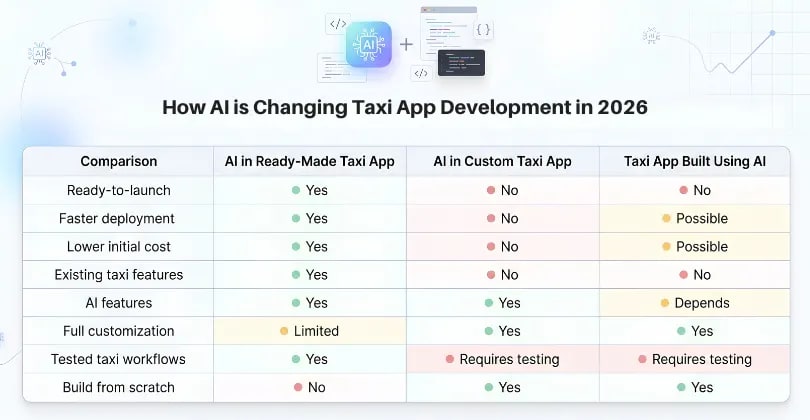
AI in White Label Taxi App
In a white-label taxi app, AI features are already built into the software by the provider. The taxi business can use these features without building AI from scratch.
For example, AI voice translation in Uber Clone enables riders and drivers who speak different languages to send voice messages that are automatically converted into text, translated, and delivered in the recipient’s language naturally.
AI in Custom Taxi App Development
In a custom taxi app, AI is built specifically around the business’s requirements and data. The business can decide what data the AI uses and how it should work.
For example, imagine a taxi operator wants to predict demand around airports. The custom app uses AI to analyze its past bookings, flight schedules, time of day, and trip patterns to predict when more rides are likely to be needed. The operator can then position drivers near the airport before demand increases.
Can AI Build a Complete Taxi App?
AI can help build many parts of a taxi app, but it cannot reliably build a complete production-ready taxi platform on its own.
AI coding tools can generate code, create app screens, write tests, and fix some bugs.
However, developers still need to plan the system, connect services such as maps and payments, manage databases, handle security, test real booking scenarios, and maintain the app.
For a taxi business, the practical approach is to use AI to speed up development while developers handle the technical decisions and final implementation.
Which Option Is Right for Your Taxi Business?
When White Label App Development Is the Right Choice
White-label apps make sense when your priority is getting operational quickly without stretching your budget or team.
Businesses with a Limited Budget
If you have a small fleet of 5 to 50 vehicles and limited funds, white-label software helps you avoid spending $60,000 to over $200,000 on custom development.
You only pay the software, setup fee, and a monthly license instead of hiring developers, designers, and quality assurance teams.
Need for Faster Market Entry
If you want to launch in under 30 days, white-label is the only option. Core features like rider booking, driver dispatch, GPS tracking, and payments are already built, tested, and ready to launch in 7 days.
Basic Feature Requirements
White-label works well if you only need:
- On-demand and scheduled rides.
- Driver and passenger apps.
- Fleet Tracking.
- Admin dashboard.
- Online payments and fare calculation.
If your operations don’t require complex rules or workflows, custom development adds unnecessary cost.
When Custom App Development Is the Right Choice
Custom app development is a good idea when your taxi business has moved beyond just MVP.
Need for Custom Features
Choose custom development if your operations need features that can’t be changed through settings.
Examples include corporate accounts with monthly invoicing, NEMT scheduling with driver compliance checks, zone-based or contract pricing, ride hailing subscription models, or multi-city dispatch rules.
These are essential business functions, and some white-label platforms often limit or charge a lot for them.
Strong Focus on Brand Identity
If your business relies on trust and positioning, such as executive transport, airport transfers, luxury taxis, or regional brands, a custom app allows you to control the entire user experience.
From the booking process to notifications and receipts, every interaction strengthens your brand instead of offering customers a generic, reused interface.
Future Growth and System Integration
Custom development is the right choice if you plan to grow and operate in more than one city or connect with accounting software, CRM tools, fleet management systems, or analytics platforms.
Custom apps manage expansion without charges for each feature, licensing limits, or vendor restrictions. This approach keeps long-term costs predictable.
It all comes down to your budget, launch timeline, customization needs, and long-term goals.
A White-label Uber clone is a practical choice for businesses that want to launch quickly with proven taxi features, but custom development is better suited to businesses that need greater control and specialized functionality.
Request a product demo
Get a demo and clarify your doubts about our software.

